The piles are in. Proving they'll hold is the part that's left.
All 155 piles were installed by Oct 2, and Cantsink's engineer has certified them. Every one passed the twisting test. The soil borings found a weak layer that the twisting test can't see, so a pass doesn't settle it.
What was built
Each pile is a steel screw. A machine turns it into the ground until the twisting force (torque) reaches a target. The harder it is to turn, the more weight it should carry. Cantsink's engineer, Dr. Souissi, signed a letter on Oct 5 saying every pile met its load.
Since then: Andrew Carter answered our questions (Oct 6, 1:57 pm), the soil borings from Oct 5 came in, and every RockSolid page and photo plus all of Murat's photos and videos were checked against the log, reading by reading (section 6).
What the borings found: a firm crust over a loose layer
On Oct 5, Quartet's driller bored two holes (B-1 and B-2) and counted hammer blows every few feet. More blows means firmer soil. Both holes show the same pattern: a firm layer around 18–21 ft, then a loose, wet layer at 23–26 ft (only 1–2 blows to start), then dense sand from about 28 ft.
This layer isn't new. Quartet's own 2025 borings logged the same "loose silty sand" at 23–25 ft. That's probably why their report set a 20-ft minimum depth.
| Depth | B-1 (Oct 5) | B-2 (Oct 5) | 2025 borings | What it means |
|---|---|---|---|---|
| 4–12 ft | organic silt 6–12 ft, bad smell, N 6–8 | sandy clay, N 8–18 | N 11–15 | Soft. Organic soil can corrode steel. |
| 13–15 ft | N 12 | N 8 | N 18–23 | Where the twelve 14-ft piles stop |
| 18–20 ft | N 23 | N 27 | N 18–20 | firm crust Most piles stop here |
| 23–25 ft | 1-1-9 (N 10) | 2-1-10 (N 11) | N 8, 9, 12 | loose Below the water table |
| 28–30 ft | N 33 | N 42 | B-3: N 15 to 40 ft | dense here, not everywhere |
N = hammer blows to drive the sampler 12 inches. Under ~10 is loose; 30+ is dense. These are the driller's handwritten field logs. Quartet's lab report hasn't arrived. The 2025 rig used an automatic hammer and the 2026 rig a manual one, so the numbers are close but not exactly comparable.
Why passing the twisting test doesn't settle it
Torque only measures how hard the soil right at the screw blade resisted turning. But a loaded blade pushes on soil 2–3 blade-widths below it, about 2–3½ ft for these 12–14″ blades. A pile that stops on the firm crust at 20 ft is pressing into the loose layer a few feet down. It can show full torque on the gauge and still settle more than expected.
We've already seen this once. In front of witnesses on 9/28, pile 12 was given a second turn after it passed. It sank through, and its torque dropped to about 2,300 below 26 ft.
The dashed outline is the soil the blade loads. Only a load test, which pushes on a pile and measures how far it sinks, can tell whether the crust is thick enough.
| Where the blade stops | Piles | Risk | Which piles |
|---|---|---|---|
| 14–17 ft (above the crust) | 30 | soft soil | Twelve at 14 ft: 18, 19, 21, 22, 23, 28, 122, 125, 126, 136, 137, 139 |
| 18–22 ft (on the crust) | 78 | loose layer 1–5 ft below | Most of the house. Dmitri's list: 46, 41, 42, 37, 71, 101, 104, 105 |
| 23–25 ft (in the loose layer) | 21 | highest | 1, 2, 5, 7, 9, 13, 14, 39, 43, 44, 45, 50, 52, 79, 87, 88, 89, 96, 131, 150, 152 |
| 26–27 ft (bottom edge) | 5 | lower | 11, 31, 138, 142, 143 |
| 28 ft and deeper | 21 | lowest | 4, 6, 8, 10, 12, 17, 27, 30, 58, 59, 61, 63, 80, 83, 92, 97, 116, 124, 127, 146, 154 |
"Net" depth = installed length minus what was cut off above ground. Cantsink writes "24′-3" meaning 24 ft installed, 3 ft cut off, so 21 ft in the ground. It isn't 24 ft 3 in. Dmitri's risk report read it the second way, so several of his depths are 3–4 ft too deep.
What Cantsink said today
Andrew Carter answered our seven questions at 1:57 pm. Juan, Scott, Dmitri, Murat and Yasamin were copied, plus Brittany and Sara Hayes. His answers, and whether each one holds up:
| We asked | Andrew said | Verdict |
|---|---|---|
| Recorded torque data | The monitor can record every 2 seconds, but they don't turn it on. A printout after the fact is "not possible." | gone No independent record exists. The handwritten logs are all there is. |
| Original field sheets | "We will collect the field logs and send them over." | promised Hold him to a date |
| Pile 17 (erased 2,717) | Pulled out completely; a 10″ blade replaced with 12″ around 9/28–29. | plausible Field sheet should show it |
| 19 "No Cut" notes rewritten | A misunderstanding with the crew leader, fixed in the final logs. He explained what each note means. | partly Field sheets will confirm |
| Pile 46 (7,003 vs video) | The number on screen changes every second; both are above 60,000 lb. | fair 7,096 is above the shaft rating, though |
| Pile 87 (6,618) | It's half of a pair that shares 100,000 lb, so it needs only 5,556. "Needs no further work." | resolved If Juan confirms 87/88 is a pair |
| The 9/24 10:47 am N·m pile | "I'm not aware of the pile you are referring to." All piles were finished in ft-lb. | unanswered Murat can identify it from the video |
| Burned bolt holes | "Noted on the final logs." | not answered The logs record no burned holes |
| Which piles are pairs | Listed all 22 pairs. 128/129 and 130/131 were doubled by mistake from staking, at no charge. | answered |
Andrew also says the piles' combined capacity beats the design total by about 500,000 lb. A house doesn't share load that way, though. Each pile carries the column or wall above it, so each one has to pass on its own.
Every pile passed its torque target, by a thin margin
Every final reading is above its target. But most are only a few percent over, and 46 are above what the shaft is rated to take (7,091). The couplings are the weak point; pile 145's coupling broke above 8,500.
Final torque in ft-lb, in 50 ft-lb steps. Single piles need 6,667; piles in a pair need 5,556. The only reading under 6,667 is pile 87, which is half of a pair. The monitor is accurate to about ±80 ft-lb.
What the photos show about the logs
The only independent check on Cantsink's numbers is what other people photographed or filmed on the tablet screen. We went through all of it: every page and photo in RockSolid's package, and 73 unique photos and videos from Murat.
| Source | Readings found | Match the log | Earlier, later redone | Problems |
|---|---|---|---|---|
| RockSolid (39 report pages, 216 photos) | 67 | 47 | 20 | 0 |
| Murat (73 unique photos and videos) | 51 | 39 | 1 | 8 (piles 4, 6, 15, 110, 111, 2, 46, and one 9/24 N·m pile) |
Every readable screen shows ft-lb after 9/24 and serial 638000EC, the calibrated monitor. Where a number was photographed, the log copies it to the digit, with the decimal dropped.
Piles 4, 6 and 15: the numbers match the log, and that is the problem
The three logged finals fall on one rising line. Between the first and last photo the screw turned only ¾ of a turn. Installing a new pile takes over 100 turns.
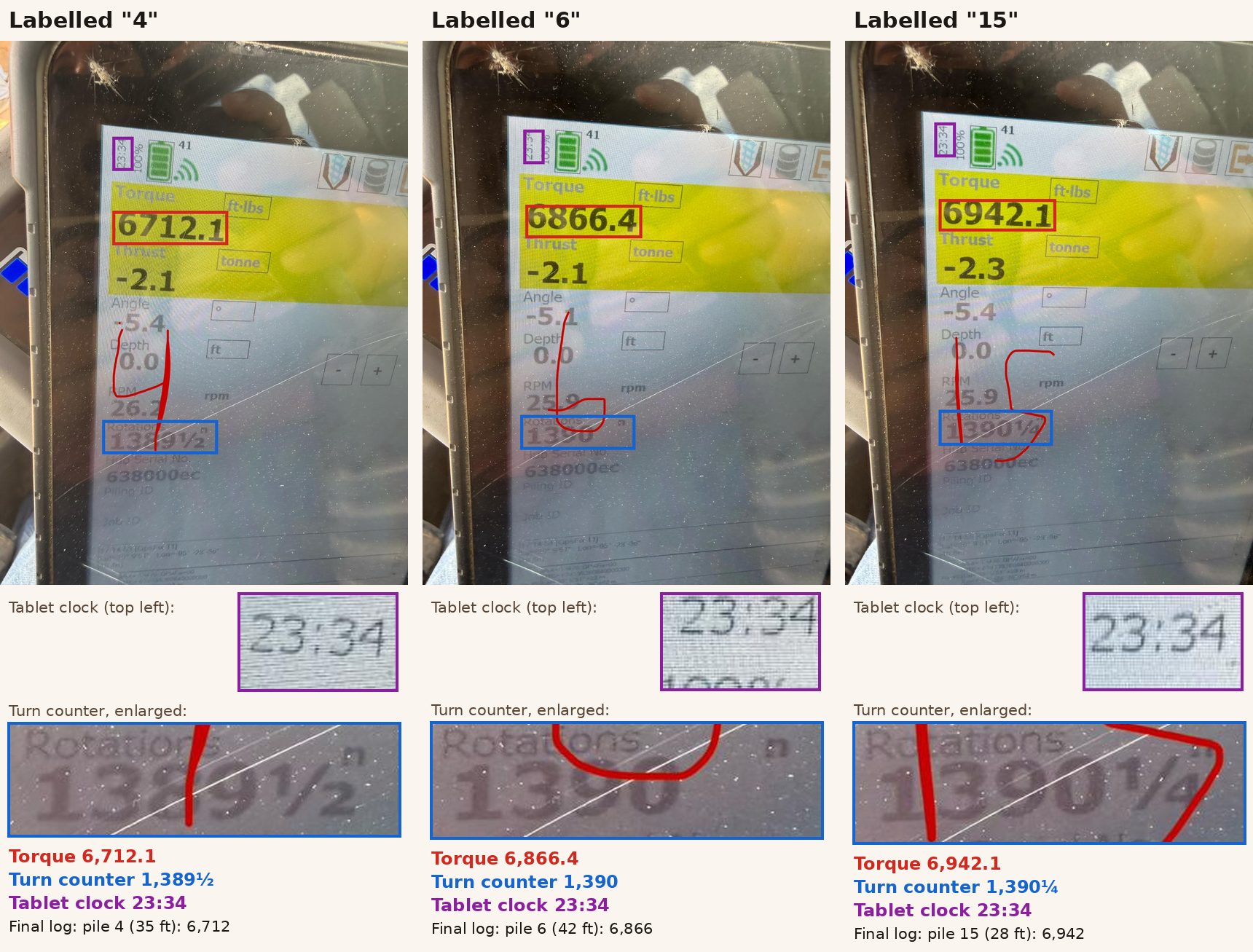
Where to look on each photo: purple box = the tablet's clock (top left), 23:34 on all three; red box = torque; blue box = the turn counter, which counts every turn the screw makes. Clock and counter are enlarged under each photo. The photo files carry no date or time data (WhatsApp strips it), and the GPS line at the bottom of the screen is too faint to read reliably, so this relies only on what is plainly legible.
| Photo | Torque | Tablet clock | Turn counter | Final log says |
|---|---|---|---|---|
| "4" | 6,712.1 | 23:34 | 1,389½ | Pile 4: 35 ft, final 6,712 |
| "6" | 6,866.4 | 23:34 | 1,390 | Pile 6: 42 ft, final 6,866 |
| "15" | 6,942.1 | 23:34 | 1,390¼ | Pile 15: 28 ft, final 6,942 |
What it means: at most one of these three logged finals belongs to its pile, and even that one isn't the true end of the drive. What it doesn't mean: it doesn't show that piles 4, 6 and 15 are weak, only that their real final readings weren't recorded. Where the photos came from (confirmed 10/7): Cantsink's own rig operator took them and texted them to Murat. The red numbers are Murat's markup; the tablet's pile-ID field is blank. Diego's field sheet (received 10/7) lists the same three numbers as the finals of three separate replacement piles, each with its own earlier readings, on a page dated 9/29. RockSolid photographed that sheet at 3:56 pm on 9/29, and the three finals were already written, in the same ink as everything else. So the numbers didn't change between the field sheet and the final log, and the sheet doesn't explain the conflict. Either the crew wrote these finals from the screen photos, or the operator photos are mislabelled. Only Cantsink can say which. A witnessed re-torque of the three piles settles whether they reach target.
Piles 110 and 111: the same problem, less certain
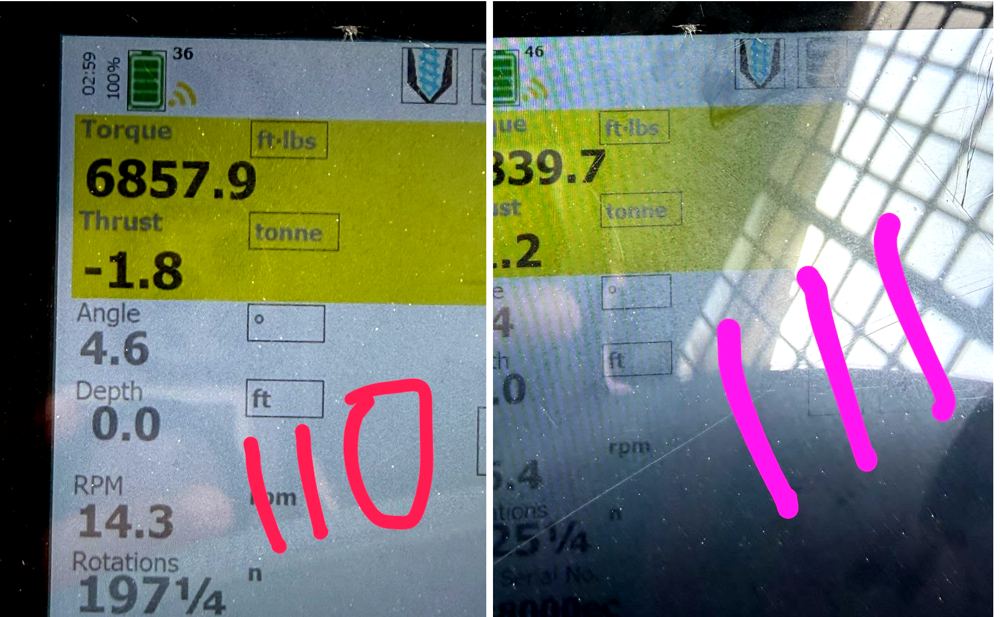
Both are logged as brand-new 21-ft piles. Screwing in a new 21-ft pile takes at least 84 turns, but between these two photos the counter moved only 28 turns, in one minute. So the second reading can't be the end of a separate new pile. It's less certain than 4/6/15 because neither photo shows a date. These are also the two readings RockSolid's inspector said she witnessed on 9/26. Her photo shows no pile number and was taken 24 minutes after her stated departure.
| Pile | What the video shows | Final log | Concern |
|---|---|---|---|
| 46 | Climbs 6,955.9 → 7,096.1 → falls; 7,003 never appears | 7,003 | mismatch True peak is over the 7,091 shaft rating |
| 2 | 6,999 on screen for half a second, then 7,069 and still rising when the video ends | 6,999 | passing value True peak unknown, may exceed 7,091 |
| 132 | Torque fell 46% partway down (5,995 → 3,225) before recovering | 6,718 | not recorded A soft layer the log doesn't show |
| 80 | About 1,230 turns before its final, roughly 7× what its depth needs | 6,765 | not recorded No extra attempts or obstruction logged |
| ? | 9/24 10:47 am, N·m: peak ≈7,520 N·m ≈ 5,547 ft-lb | none matches | unidentified Andrew: "not aware of the pile" |
Settled
- Units: every final is in ft-lb. The tablet switched on 9/24 between 10:47 am and 3:33 pm.
- Calibration: serial 638000EC on every screen and stamped on the rig. That is the unit calibrated June 1, 2026.
- No photographed value contradicts the calibrated monitor or the units.
- Pile 87: covered as half of a pair, pending Juan.
Still open
- About 60 of 155 piles have a photo of their final reading. Murat and Dmitri photographed 45; RockSolid's inspector photographed or recorded 17. They overlap at 110 and 111. Most of these match the log, apart from 4, 6, 15, 110, 111, 46 and 2 (above). The other ~95 piles rest on Cantsink's handwritten log alone.
- Dunaway's own inspector (RockSolid) wrote down a reading she personally saw for just 2 piles, 110 and 111. Her other entries copy Cantsink's numbers. Murat's and Dmitri's photos are good evidence, but they're the owner side's, not Dunaway's.
- The log's finals look like they were read from these same screens, not recorded pile by pile.
- First attempts left off the final log: original 10″ piles 110 and 111 (about 5,550 ft-lb), 93, 94, 95 and an early pile 80. Pile 145: "snapped lead."
- No raw data exists. Diego's 13 handwritten field sheets arrived 10/7: 144 of 155 piles match the final log. Differences include copying slips (piles 9, 80, 117), depth or cut-off differences on 35, 115, 118 and 124, 31 replaced first attempts left off the final log, and field notes the final log omits (pile 154 "moved 1′ due to obstruction"; pile 145's snapped lead).
- Piles 109 and 125 first appear on the final log. Pile 12's original test isn't in it.
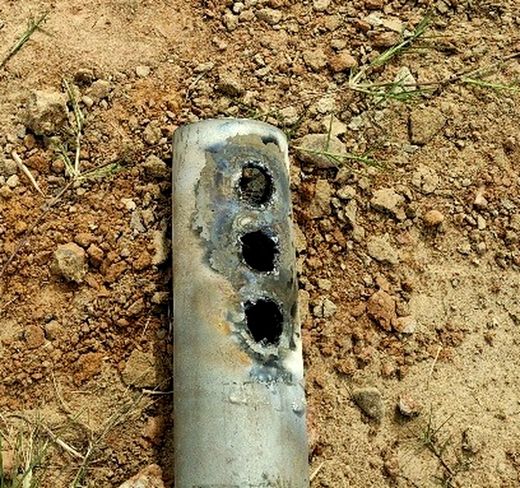 Burned bolt holes. RockSolid's own 9/26 photo shows a cut shaft with three torch-cut holes. Andrew says they are "noted on the final logs." The logs don't note any.
What this could cost
| Item | Amount | Basis |
|---|---|---|
| Cantsink base (via Keystone) | $86,700 | Proposal: piles to 17 ft |
| Depth over 17 ft, if billed | $23,058 – $33,684 | $28/ft × 824 ft (net depth) to 1,203 ft (installed length). Only through a signed change order (Keystone addendum §7). |
| Two extra piles (128–131) | $0 | Andrew: "will not be charged to anyone" |
| Torque check, 6 piles (Quartet QGH-26-0221B) | $11,380 | Quoted 10/6: one day, 3-person crew, welding adapters onto the cut pile heads. About $1,900 per pile. No report, no load test. Not signed. |
| Load test on 2–3 piles | not quoted | Excluded from Quartet's proposal as "additional fees"; asked for 10/2 |
Cutting the pile tops before testing is what makes testing expensive: every test pile now needs an adapter welded on. Range only. Which depth Cantsink bills on (installed length or depth in the ground) isn't settled, and nothing has been invoiced.
So what do you do?
The next tab lays out the steps in order, with who owns each one and what has to be true before concrete is poured.
10 · What To Do