25 Aria Isle Dr · Lot 4 · The Woodlands, TXWhat the Evidence Shows · 10/08/2026
Updated Thu Oct 8, 2026 · records review

Most of the paperwork adds up. A few records don't.

We checked Cantsink's pile logs (nine versions, from the handwritten field sheets to the certified FINAL) against every independent photo, video and inspector record we have. Here is what matches, what contradicts, and what nobody can check.

✓ Consistent

Cantsink's numbers mostly agree with each other and with the photos.

144 of 155

piles where the handwritten field sheet matches the FINAL log exactly. No photo or inspector reading shows a different final, except the piles in the red box.

○ Unchecked

But only about 1 pile in 3 has any independent check.

50 of 155

piles have a tablet photo or video that matches the logged final. 98 have nothing outside Cantsink's own paper.

✕ Contradicted

A handful of records contradict the photos.

7 piles

where a photo or video shows something other than the logged final: 2, 4, 6, 15, 46, 110, 111. Two more records were erased or held back: 17 and 125.

! What it means

Nothing shows a pile is weak. It shows the paperwork can't be fully trusted.

0 piles

whose FINAL reading is below its target torque. That's why a witnessed re-torque and a load test matter. (The soil question on tab 09 is separate.)

Words used on this page

Torque
The twisting force needed to screw a pile into the ground. The harder it is to turn, the more weight it should carry. Measured in ft-lb. Until 9/24 the tablet showed N·m, a different unit (1 N·m ≈ 0.74 ft-lb).
Final
The torque reading at the very end of a pile's drive. It's the number that proves the pile.
Target
6,667 ft-lb for a single pile. 5,556 for each pile of a slanted pair, because two piles share the load.
Depth and cut-off
"35′−3" means 35 ft of steel went in and 3 ft was cut off the top. So 32 ft is in the ground (the "net depth").
Field sheet vs FINAL
Diego, on Cantsink's crew, wrote readings by hand on field sheets. The FINAL (10/5) is the clean copy that Cantsink's engineer certified.
Turn counter
The tablet counts the pile's turns. Each turn moves it down about 3 inches at most, so a 21-ft pile needs at least 84 turns.
1

All 155 piles at a glance

Each square is one pile. The colour says how well its logged final is backed up. Tap or hover a square to see that pile's one-line status. Tap a colour below to pick out just those piles.

Pile —Tap a square to see what the records say about that pile.

Green means a photo backs the final. Some green piles still carry a paperwork note, such as pile 80's unlogged failed attempt; the status line says so. Of the 53 amber piles, 35 have a moderate problem (most often a rewritten repair note or a dropped first attempt) and 18 a minor one (a copying slip or page date). Section 4 explains each kind.

2

Where the evidence agrees

This part is good news. Wherever someone outside Cantsink photographed a final, it almost always matches the log, and the log's many copies agree with each other.

  • ft-lbThe units were fixed after 9/24.

    Every readable tablet screen after 9/24 shows ft-lb, and every final in the FINAL log is in ft-lb. The early N·m readings belong to piles that were later re-driven or replaced.

  • 638000ECOne calibrated monitor, all job long.

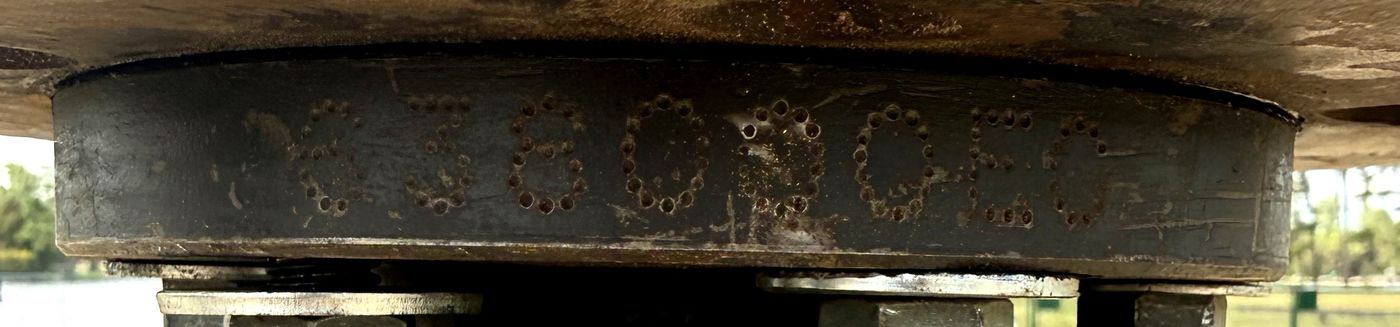
    That serial shows on every legible tablet screen and is dot-punched on the rig's hub. It's the monitor with the June 2026 calibration certificate.

  • 47 / 67RockSolid's readings match.

    RockSolid is the third-party inspector. Its reports and photos hold 67 torque readings, mostly photos of the tablet or of Cantsink's sheets. 47 match the log exactly, 20 are earlier readings from before a redo, and 0 disagree.

  • 39+Murat's and the operator's photos match.

    39 tablet photos and videos show exactly the logged final (the log just drops the decimal). 5 more match the number but can't be real, separate finals; see section 3. Murat's handwritten notebook is not counted here: it repeats Cantsink's numbers to the digit, including the contradicted 4, 6, 15 and 46, so it was copied from the tablet or the operator.

  • 144The FINAL is a faithful copy of the field sheets.

    On 144 of 155 piles, torque, depth, cut-off and helix all match. The final torque matches on 153 of 154. So the problems are in what the field sheets recorded, not in the copying.

  • 155 / 155Every FINAL reading meets its target.

    111 single piles need 6,667; 44 piles in 22 slanted pairs need 5,556. Pile 87 (6,618) is half of pair 87/88, so it passes. 46 finals are above the shaft's 7,091 rating; they're logged the same way everywhere, so that's a question for Juan (Dunaway), not a records problem.

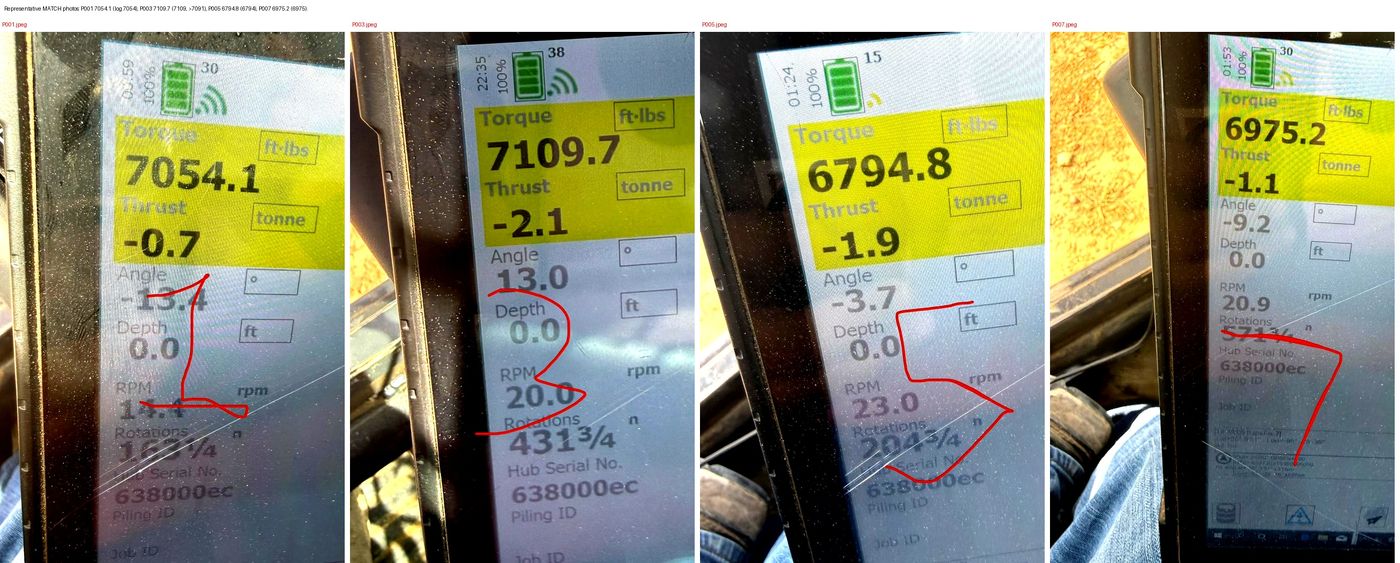
Four tablet photos showing torque readings 7,054.1, 7,109.7, 6,794.8 and 6,975.2 ft-lb, each with hub serial 638000ec
Typical matches: piles 1, 3, 5 and 7. Each screen shows ft-lb and hub serial 638000ec, and each reading is in the log without the decimal.
Rig hub with 638000EC dot-punched into the steel
The serial 638000EC dot-punched on the rig's torque hub (RockSolid photo, 9/30).
3

Where it contradicts

These are the serious ones. In each, either a photo shows something different from the log, or the log was changed in a way that hides what happened. Piles 4, 6 and 15 are the most important.

Piles 4, 6 and 15

✕ Photo contradicts
What the record says

Three separate replacement piles, 35, 42 and 28 ft deep, with finals of 6,712, 6,866 and 6,942.

What the evidence shows

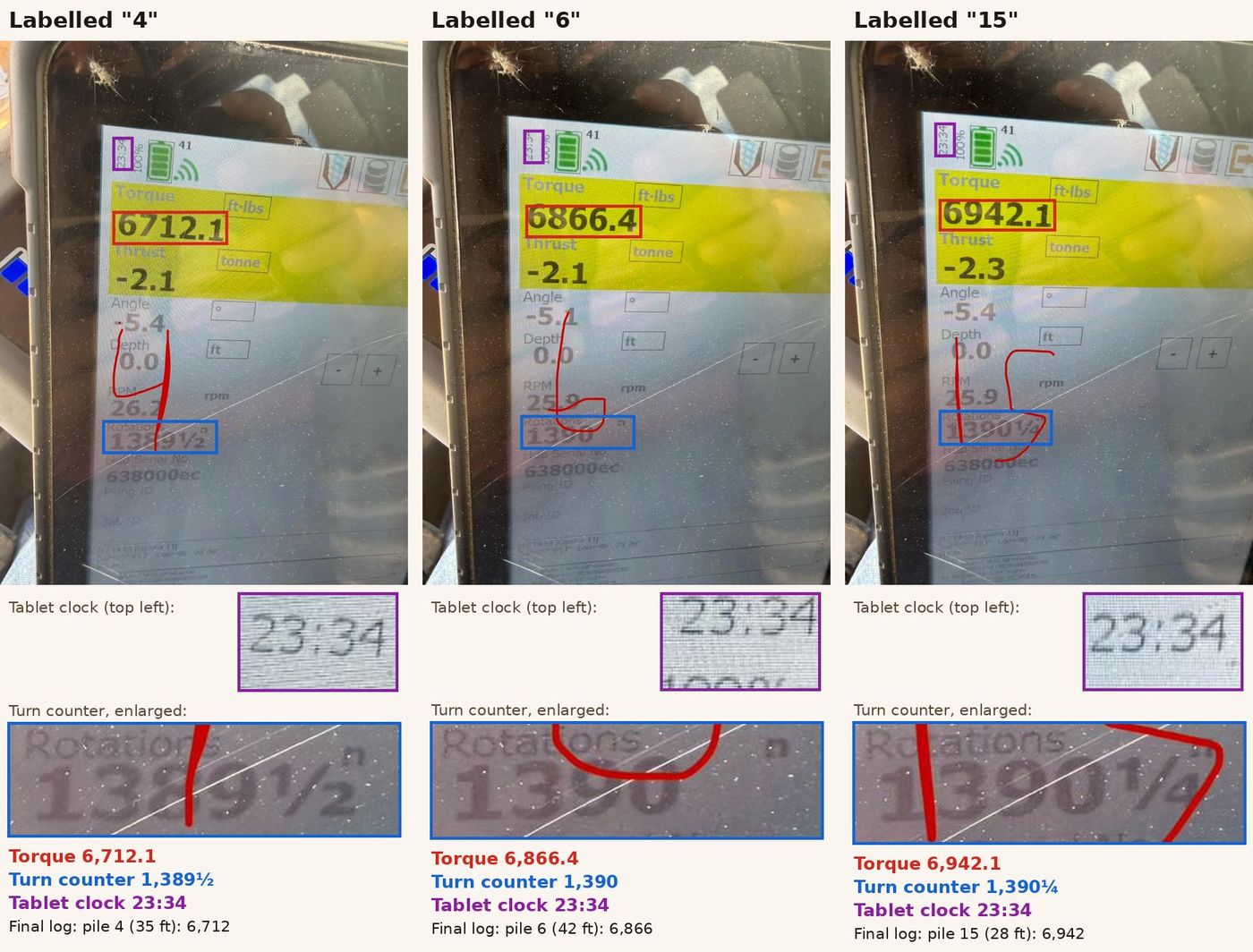
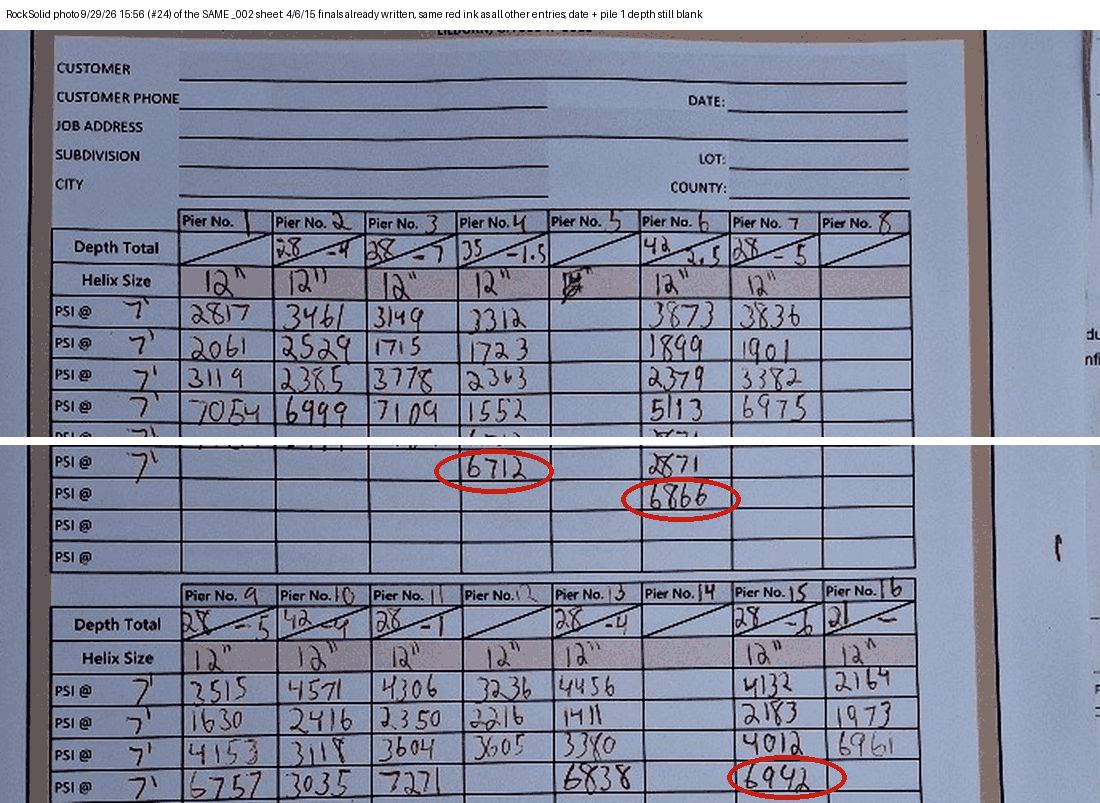
Cantsink's own rig operator photographed the tablet three times and texted the photos to Murat. The three photos are about one second apart, the turn counter moved only ¾ of a turn (1,389½ → 1,390¼), and the torque was still climbing. That's one pile being driven, not three finished piles. RockSolid's photo of Diego's field sheet at 3:56 pm on 9/29 shows all three numbers already written as the finals, in the same ink as everything else. So the numbers went onto the field sheet that day; they weren't added later in the office.

Why it matters

At most one of these three numbers can be a real finishing reading. The other two piles have no genuine final on record. 54 billed feet rest on them.

See the photos yourself → tab 11
Three tablet photos labelled 4, 6 and 15, showing 6,712.1, 6,866.4 and 6,942.1 ft-lb, turn counter 1,389½ to 1,390¼, clock 23:34 on all three
The three operator photos. Red: torque, still rising. Blue: the turn counter moves ¾ of a turn. Purple: the tablet clock is the same minute on all three.
RockSolid photo of Cantsink field sheet with the finals 6712, 6866 and 6942 circled
RockSolid's photo of the field sheet, 9/29 at 3:56 pm. Circled: the three finals, already written. The sheet's date line is still blank.

Piles 110 and 111

✕ Photo contradicts
What the record says

Both original piles were pulled out and replaced with new 21-ft piles. Finals 6,857 and 6,839. These are the only two finals RockSolid says it witnessed.

What the evidence shows

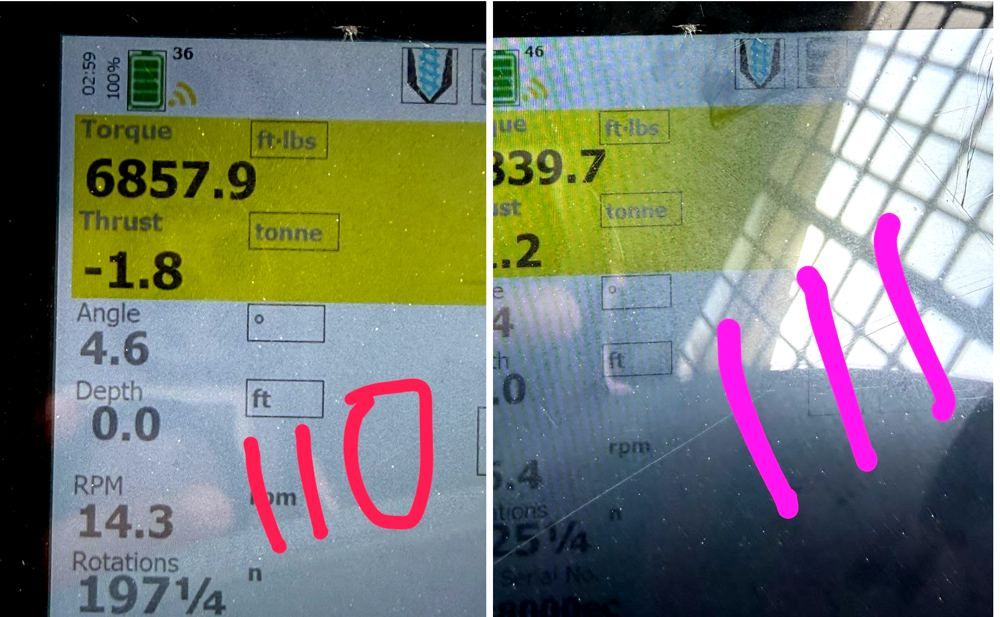
The two tablet photos are about a minute apart (clock 02:59 → 03:00), and the turn counter moved only 28 turns (197¼ → 225¼). A brand-new 21-ft pile needs at least 84 turns. So the second photo can't be the end of a separate, complete pile.

Why it matters

Two piles' finals can't both be right, and they are the only finals a third-party inspector claims to have seen. The tablet showed no pile number and a depth of 0.0, and it isn't known who took the 110 photo.

See the photos yourself → tab 11
Two tablet photos labelled 110 and 111 showing 6,857.9 and 6,839.7 ft-lb, rotations 197¼ and 225¼
The two photos. Left: 6,857.9 at 197¼ turns. Right: 6,839.7 at 225¼ turns, 28 turns later.

Pile 46

✕ Video contradicts
What the record says

Final 7,003. The same number is on Diego's field sheet, Murat's table and the FINAL.

What the evidence shows

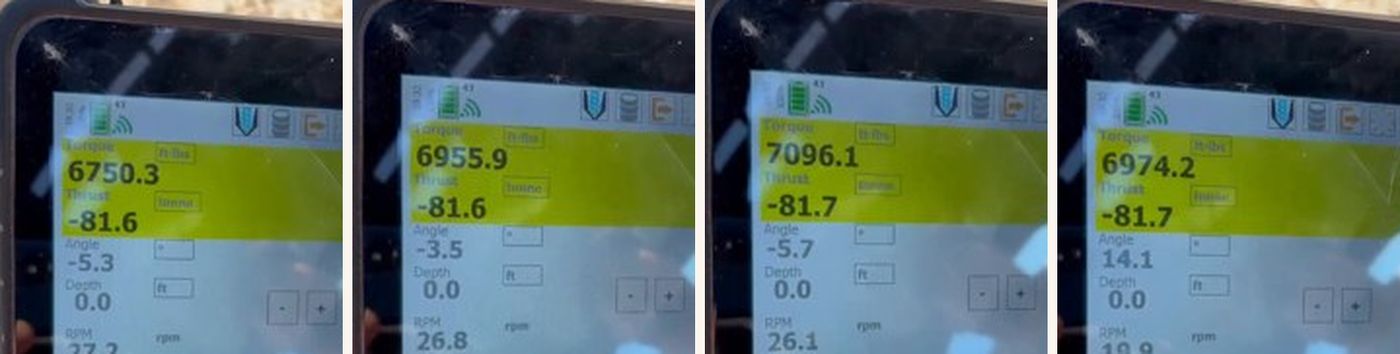
Dmitri filmed this drive on 9/25. Read frame by frame, the screen goes 6,750 → 6,956 → 7,096 (the peak) → 6,974. 7,003 never appears.

Why it matters

The logged number wasn't read off the screen. The real peak, 7,096, is just above the shaft's 7,091 rating.

See the photos yourself → tab 11
Four video frames of the tablet: 6,750.3, 6,955.9, 7,096.1 and 6,974.2
Four frames from the 9/25 video, in order: 6,750.3 → 6,955.9 → 7,096.1 (the peak) → 6,974.2. The logged 7,003 is never on screen.

Pile 17

✕ Failing record erased
What the record says

FINAL: a replacement pile, 35 ft, 12″ helix, final 6,789.

What the evidence shows

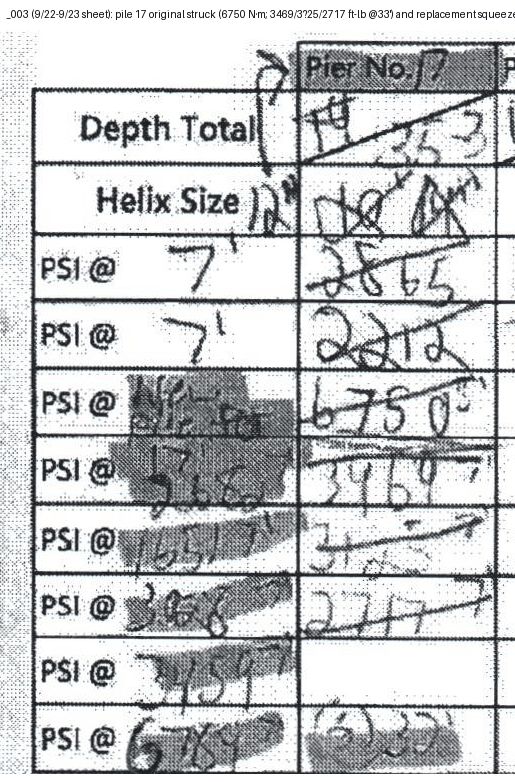
The 9/25 log showed this pile at 40 ft with a 10″ helix and a final of 2,717, far below the 6,667 target. From 9/29 on, that column was erased and rewritten; the 2,717 is still faintly visible on the FINAL. Diego's field sheet shows the old readings struck through, and the replacement squeezed into the margin. RockSolid did see the helix swapped from 10″ to 12″ on 9/28, Murat's photo shows 6,789, and Murat's notebook still has a faint "40" ft and a 10″ helix for this pile, which fits the erased first drive being real.

Why it matters

A replacement probably happened. But the record was overwritten instead of showing the failed attempt and then the redo. Erasing a failing number is exactly the kind of edit that makes the rest of the paperwork hard to trust.

See the photos yourself → tab 11
Field sheet column for pile 17 with original readings struck through and replacement readings in the margin
Diego's field sheet, pile 17. The original readings (including 2,717) are struck; the replacement is squeezed into the left margin.

Pile 125

✕ Held back
What the record says

FINAL (10/5): 14 ft, 10″ helix, final 7,116, "No Cut".

What the evidence shows

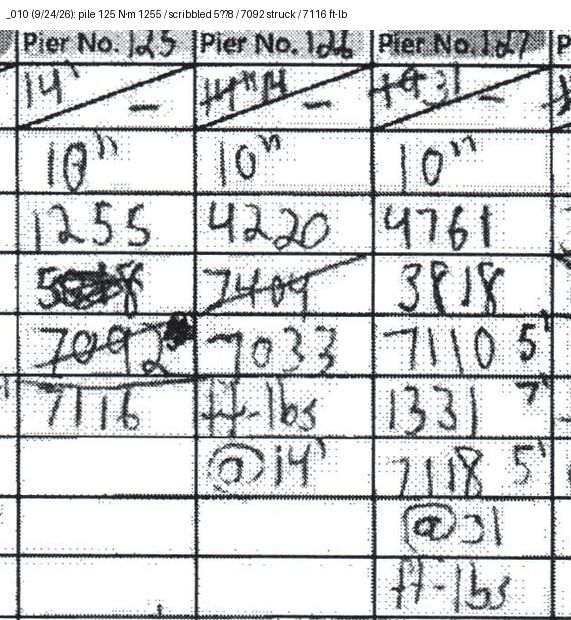
Diego's 9/24 field sheet already has this pile complete, with early N·m readings. Yet the log sets sent on 9/25, 9/29 and 9/30 left it off (the last two show only its helix size). It first appears in the 10/5 FINAL. No photo of its final exists.

Why it matters

A finished pile was missing from three versions of the logs. It's also one of the twelve shortest piles (14 ft), and nothing independent confirms it.

No photo of this pile exists. The field sheet above is the only record.
Field sheet columns for piles 125 to 127; pile 125 shows 1255, a scribbled reading, 7092 struck, then 7116
Diego's 9/24 sheet: pile 125 (left) with 1,255, a scribbled reading, 7,092 struck, then 7,116.
4

Smaller paperwork problems

These don't contradict a photo, but they show the logs were edited and re-copied over several days. Altogether 89 piles have at least one problem (8 serious, 41 moderate, 40 minor), 45 were legitimately redone, and 21 agree everywhere. One pile can appear in several rows.

WhatHow manyWhat it means
Pile 2: a passing value was logged2
1pile

The log says 6,999. On the video, 6,999 was on screen for about half a second; the video ends at 7,069 and still rising. The number passes, but it wasn't the end of the drive.

Repair notes rewritten8, 24, 27, 30, 64–68, 70, 72, 74, 75, 77, 99, 101, 129–131
19piles

On 9/25 these said "No Cut". From 9/29 they say "Cut & extension added" or similar. The readings didn't change. The field sheets never say "No Cut", and 15 of the 19 now say "cut" and are on Cantsink's own list of torch-cut piles, so the new labels may be the true ones. Four don't fit: 66 (on the torch-cut list, still says "No Cut"), 67, 129 and 130. "No Cut" was also added after 9/25 to 6 more piles.

First attempts and notes left out12, 80, 93–96, 109–112, 125, 145, 154
13piles

The FINAL drops things that are on the field sheets or in photos: the original 10″ piles 93–96, 110 and 111; pile 12's original; pile 80's failed attempt; pile 145's snapped lead (first reading 4,995); pile 154's move of 1 ft toward 155 for an obstruction. Piles 109 and 125 were left off earlier copies.

Depth, cut-off or helix changed23, 24, 33, 36, 62, 66, 67, 91, 108
9piles

Changed between versions with no note. Pile 66: the field sheet shows 26 ft installed, the FINAL 21, so the FINAL under-states it by 5 ft. Pile 108's 4-ft cut-off is a real field value that two copies dropped, not a late edit.

Values erased or written over5, 17, 43, 109, 119, 125, 139
7piles

Struck or scribbled readings on the field sheet that the FINAL doesn't show. Piles 17 and 125 are the serious ones (above); the rest are abandoned readings.

Copying slips9, 35, 50, 57, 61, 63, 73, 75, 79, 80, 89, 92, 97, 115–118, 124, 136
19piles

Mostly single-digit slips in the in-between readings (about 20 in roughly 900), for example pile 9's first reading: 2,515 on the field sheet, 3,515 in the FINAL. A few cut-offs differ by a foot or two (35, 115, 124). Only one final differs: pile 117 (7,004.2 on the field sheet, 7,009 in the FINAL).

Same number as another pile129, 130
2piles

Piles 129 and 130 share their finals with piles 123 and 125. Cantsink says 129 and 130 were "doubled by mistake".

Page dates13, 52, 112–115, 119, 120, 129–147, 150, 153, 155
30piles

The dates on the field sheets conflict with the units used, with the other log sets, or with photo time stamps. For 20 piles this is the only issue. No pile can be reliably dated from Cantsink's paper.
5

What we can't check

For 98 of 155 piles there is nothing outside Cantsink's own paper that shows the final reading. That doesn't make them wrong. It means we have to take Cantsink's word for them. Murat's notebook doesn't change this: it was copied from the same tablet and operator readouts.

65: no photo or video at all21: only a photo of Cantsink's own sheet12: only an earlier reading, from before the redo

Why: no tablet log was kept

The torque tablet runs Pro-Dig's H200 app. It can record each pile automatically: type in a pile number, press "Start Logging", and it saves that pile's whole drive and exports it as a spreadsheet file. On every screen we've seen, the pile-number field is blank and depth reads 0.0. Cantsink says a printout isn't possible. The app says otherwise. If no file exists, it's because nobody pressed "Start Logging". Untagged files may still be on the tablet.

The tablet clock is wrong, but it runs

The tablet thinks it's late April 2026: its clock is set about 148 days behind. It keeps time normally, so it isn't frozen or broken. If any log files do exist, they'll be dated April, not September. Whoever asks for them should say so, or the files could be thrown out as the wrong job.

The inspector saw only two

RockSolid recorded a witnessed final for just 2 of 155 piles: 110 and 111. Those are the two the turn counter contradicts (section 3). Everywhere else, RockSolid wrote "Operator Records" or "CANTSINK".

6

What it means for money

Cantsink's invoice 1235 bills extra depth: every foot beyond 17 ft per pile, at $28/ft. It counts the steel that went in, including what was later cut off the top.

Billed (steel installed)
1,201 ft · $33,628
In the ground (net depth)
823.5 ft · $23,058
377.5 ftdifference between the two: $10,570 at $28/ft, before Keystone's 8% fee. Which one the contract means is a question for Keystone and the contract.
550.5 ftof the 823.5 in-ground feet are on the 89 piles with at least one paperwork problem (767 ft counted as billed).
54 ftbilled on piles 4, 6 and 15 ($1,512), whose finals came from one drive.
$5,768Cantsink's discount: all 206 extra feet on 12 named piles. It doesn't touch any of the contradicted piles.
7

What would settle it

None of this needs an argument about who wrote what. Three things answer it directly.

  1. 1Re-torque the contradicted piles, with a witness.

    Piles 2, 4, 6, 15, 46, 110, 111 (tab 10's group D). Film the whole drive, with a third party watching. It shows whether each pile really holds its logged torque.

  2. 2Load-test 2–3 piles.

    A re-torque shows the screw still grips. Only a load test shows the soil under it holds the weight. Juan (Dunaway) picks the piles.

  3. 3Get Cantsink's own records.

    The tablet's log files (an export from the H200 app; expect April 2026 dates), colour copies or the paper originals of Diego's field sheets (the highlighter colours code each repair), and a written explanation of piles 17, 46 and 125 and the rewritten repair notes.

10 · What To Do: the full test plan →

This is a review of records, not an engineering opinion. Accepting any pile is for Dunaway (Juan Gonzalez, PE). Nothing on this page has been sent to anyone.

Sources (all in foundation/status-review-2026-10-05/):

  • I_all_logs_reconciliation.md and I_all_logs_matrix.csv (10/8, with Murat's PaperWork uploads, source J): pile-by-pile reconciliation of nine log sets, cross-checked against Murat's notebook and spreadsheet (not independent) and colour close-ups of Diego's field sheets. Every count on this page is computed from the matrix.
  • H_field_sheets_vs_final.md: Diego's 13 handwritten field sheets vs the FINAL.
  • F_murat_field_media_vs_logs.md and .csv: 73 unique photos and videos from Murat and Cantsink's operator.
  • E_rocksolid_all_pages_visual_review.md and E_rocksolid_torque_observations.csv: all 39 RockSolid pages and 216 photos.
  • G_tablet_clock_explained.md: the tablet clock and Pro-Dig's H200 logging.
  • A_final_verified.csv and 00_COMBINED_STATUS.md.

Corrections already applied: pile 6's 4th reading is 5,113 (an earlier "5,713" was our own misread, not Cantsink's); pile 108's −4 cut-off is a field value, not a late edit; pile 87 is half of pair 87/88 and meets its 5,556 target. Billing figures are arithmetic on invoice 1235 (10/7) and Keystone COR #2 (10/8).

Prepared Oct 8, 2026 for 25 Aria Isle Dr, Lot 4. Generated by foundation-deploy/tools/pile-evidence/build_evidence.py.